
There’s a version of this post where I try to define creativity in the first paragraph and tie everything up neatly by the last. That’s not this post.
Partly because the more I’ve read about creativity—the neuroscience, psychology, philosophy, biographies, spiritual traditions, and research—the less convinced I’ve become that it lends itself to clean definitions. Every time I think I’ve pinned it down, it seems to show up somewhere I wasn’t expecting.
But I think there’s another reason too.
I don’t think I became interested in creativity because I wanted to understand creativity. I think I became interested in creativity because I was trying to understand myself.
For most of my life I’ve been drawn toward an unreasonable number of things. Writing. Storytelling. Photography. Technology. Startups. Design. Watches. Books. Music. Business. AI. Every few years I’d become convinced that one of those interests would reveal itself as the thing. The path that would finally explain all the others and justify abandoning the rest.
It never happened.
At one point I wrote an entire book called The Master Generalist, which in retrospect may have been less a career philosophy and more an attempt to justify my inability to stay in a single lane.
Why did I keep bouncing between interests? Why was I constantly collecting new ones? Why did I seem more interested in connections between fields than mastery within a single field?
Creativity kept appearing at the center of those questions, so I started pulling on that thread. Over the years I’ve searched for answers everywhere and from every direction: musicians like John Coltrane and Rick Rubin, writers like Austin Kleon and Julia Cameron, entrepreneurs like Steve Jobs, philosophers like Emerson and Osho, along with psychologists, scientists, and researchers whose names most people would never recognize.
The details often disagreed. The language certainly did. But beneath those differences, I kept noticing the same underlying ideas emerging again and again.
Rodriguez gave one of the clearest expressions of one of them:
Filmmaker Robert Rodriguez once said:
“You can be creative in everything you do. You can be creative when you make dinner. You can be creative in how you raise your kids… Just live a creative life.”
At the time I thought it was simply a nice way of describing creativity. Years later I realized it was describing something much bigger.
Because the conclusion I arrived at wasn’t that I had finally figured out creativity.
It was that I’d been asking the wrong question all along.
I wasn’t looking for the right hobby, career, or discipline. I was looking for the thing that connected all of them.
Creativity isn’t really about art. Or at least it isn’t only about art.
It’s a way of engaging with the world.
And once I started looking at it that way, a lot of things that previously felt disconnected began to make more sense.
Nothing Comes From Nothing
If there’s one thing nearly everyone seemed to agree on, it was this:
Nothing comes from nothing.
Or perhaps more accurately, everything comes from something. Ideas come from other ideas.
For a long time, I resisted this idea because it felt strangely deflating. I wanted originality to mean creating something entirely new. To bring something into the world through imagination alone.
But the more examples I encountered, the harder that position became to defend.
Austin Kleon provocatively argued that artists “steal”—that creative work is less about inventing from scratch than transforming what already exists. The deeper I went, the more versions of that same idea I kept encountering.
The pattern was difficult to ignore.
Creativity is combinatorial.
I didn’t love that conclusion at first. It felt like it diminished originality. Eventually I started seeing the opposite. Combination expanded where originality could come from.
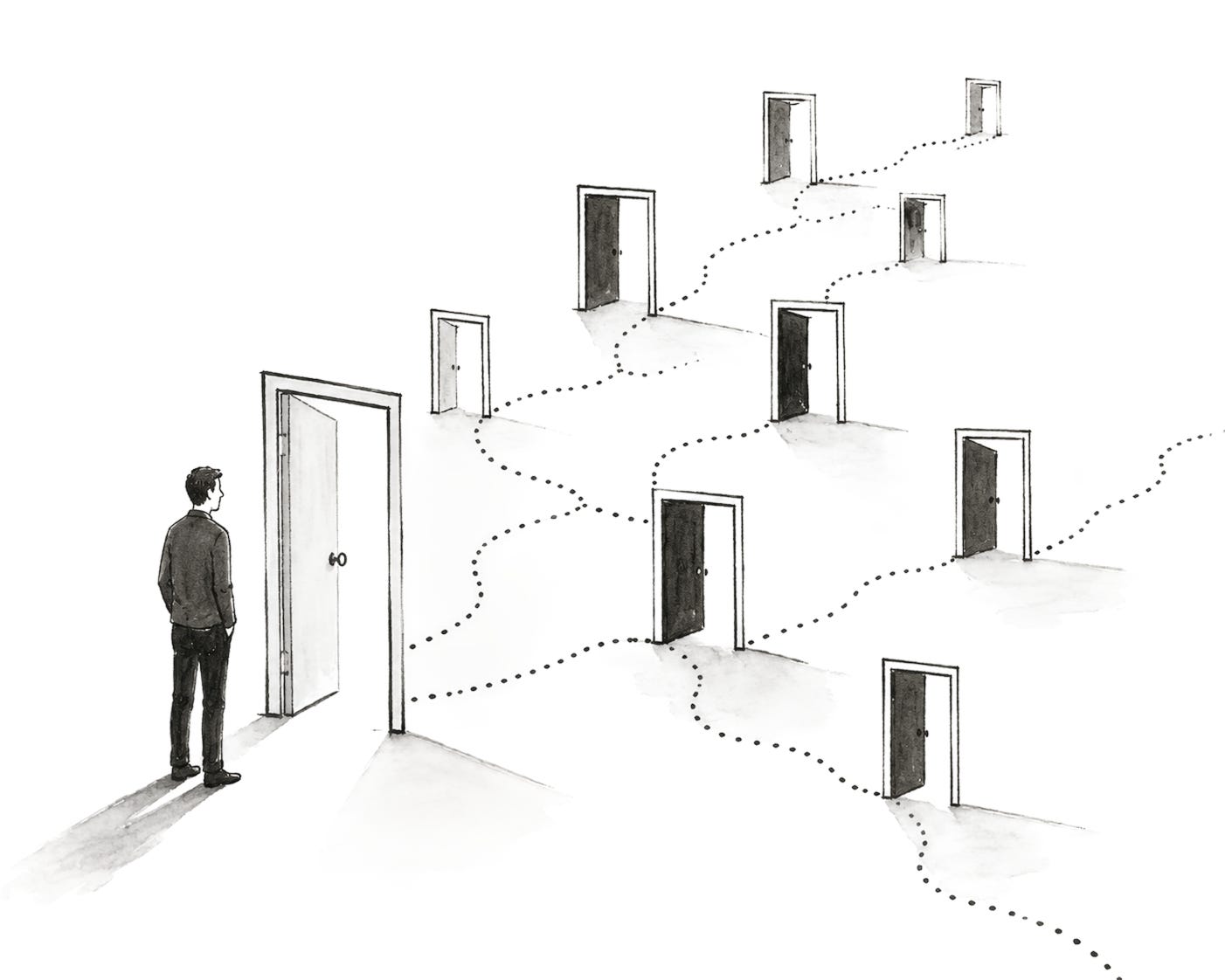
The most useful framework I’ve found comes from Steven Johnson’s idea of the adjacent possible. He asks us to imagine a house that magically expands every time a door is opened. Each room contains doors that couldn’t be accessed before. Open one and new possibilities appear. Open enough of them and the house grows into something far larger than what was visible from the entrance.
Ideas work much the same way.
A new technology creates possibilities for new businesses. A scientific discovery enables new fields of research. A chance conversation unlocks a solution that had been sitting just beyond reach.
It also described something I’d been doing instinctively for years without having a name for it.
What I had previously viewed as a lack of focus started looking more like a search for raw material.
Writing changed how I thought about composition in photography. Design changed how I approached building a business. AI ended up becoming another creative medium rather than just another technology.
And every so often, two seemingly unrelated interests would collide and produce something neither one could have generated alone.
The question isn’t whether you’re capable of originality. The question is whether you’ve given yourself enough material to work with.
You can read widely. Follow curiosities that don’t seem immediately useful. Explore unfamiliar subjects. Collect experiences that feel unrelated to the work in front of you.
In other words, you can keep opening doors.
Maybe that’s what I was doing all along.
Everything Passes Through a Person
The idea that creativity is combinatorial answered a lot of questions for me.
It explains why breadth matters. It explains why so many breakthroughs happen when ideas from different domains collide.
But it doesn’t explain everything.
Because at some point another question starts to emerge. If creativity is just combination, why do people create such different things from the same raw materials?
Two people can read the same books, listen to the same music, visit the same places, and use the same tools. They can even arrive at the same ideas. Yet somehow the outputs still feel different.
One person’s work resonates with you. Another person’s doesn’t.
One product feels thoughtful. Another feels generic.
One photograph feels alive. Another feels technically perfect but empty.
For a long time I assumed the difference was skill. Now I’m not so sure. I think a lot of what we call creativity is actually self-expression.
Not in the sense that every creative act is autobiographical, but in the sense that every creative act passes through a person before it enters the world.
The ingredients may be shared. The filter is not.
Taste isn’t just preference. It’s accumulated attention. It shapes what captures your attention in the first place: the ideas you collect, the patterns you notice, the questions you keep returning to, and what you decide is worth exploring further.
The world offers an effectively infinite amount of input. None of us can take it all in. Over time, taste determines what survives contact with your attention, and those accumulated choices become the lens through which you create.
Looking back, I can see that lens showing up everywhere in my own life.
My fascination with stories eventually led to writing. Writing led to blogging and a book. An interest in design led to photography, products, fashion, and watches. Curiosity about technology led to software, building apps, and enabling AI. Even the businesses I’ve been drawn to over the years, from customized shampoo to embedded finance, have usually had less to do with the industry itself and more to do with the underlying puzzle.
At the time, these interests felt unrelated. In hindsight, they feel more like different expressions of the same thing.
Which is perhaps why I’ve become less interested in whether something qualifies as art and more interested in whether it reflects a point of view.
Creativity isn’t just the rearrangement of ideas. It’s the rearrangement of ideas through the lens of a particular life.
That’s the part that can’t be copied.
Making Room For Creativity
One of the striking things about reading widely on creativity is how often people end up describing the same process using completely different language.
Scientists talk about insight and association. Psychologists talk about synthesis. Artists talk about inspiration. Spiritual traditions talk about the muse. Entrepreneurs talk about innovation. The vocabulary changes. The underlying shape doesn’t seem to.
There’s a romantic myth about creativity. The myth says inspiration strikes the innocent. That knowing too much somehow contaminates originality. That the best ideas arrive untouched by influence.
It’s a beautiful idea.
It also doesn’t seem to be how creativity actually works.
The deeper I went into the lives of people I admired, the harder it became to find examples of creativity emerging from a vacuum. Scientists spend decades learning the existing map before discovering a new piece of territory. Writers read constantly. Filmmakers watch films. Entrepreneurs become obsessed with markets, customers, and problems long before they arrive at an insight worth pursuing.
You can’t combine what you don’t have.
Once you’ve gathered the material, you have to let it sit.
That’s the part I think most of us underestimate.
We tend to think of creativity as a purely active process. As though pushing harder, consuming more, thinking longer, or working later will inevitably produce better ideas. Nearly every framework I’ve encountered suggests something different. Einstein described it as combinatory play—the idea that stepping into a different mental activity can unlock progress on the problem you were trying to solve.
For Einstein, that often meant putting his work aside and picking up his violin. When he found himself stuck, he would play for hours, and more than once he described the solution arriving during or shortly after those breaks. The work hadn’t stopped. It had simply moved somewhere beyond conscious effort.
But time alone isn’t enough.
Rick Rubin describes creativity as an act of noticing more than producing. Julia Cameron writes about the ways fear, resentment, distraction, and self-sabotage block creative work long before the work itself begins. Even traditions that have nothing to do with art arrive at a similar conclusion: your inner state affects what you’re capable of seeing.
I’ve rarely struggled to generate ideas. I’ve struggled to create the conditions where those ideas can surface.
Busyness narrows your attention. Constant consumption fills every empty space. The pressure to make something good has a way of evaluating ideas before they’ve had a chance to develop. The need for every project to justify itself squeezes out the playfulness that often produced the idea in the first place.
Creativity seems to ask for a strange balance. You have to pursue it, but you also have to leave room for it to find you. You gather the material, do the work, and stay engaged—but eventually you have to stop pulling on it and let your mind make the connections on its own.
Maybe that’s why research on insight consistently finds that breakthroughs often happen away from the task itself. The mind keeps working even when our attention appears to have moved on. The walk, the shower, the drive home—they aren’t where creativity begins. They’re often where it finally catches up.
You can’t schedule a breakthrough.
You can’t put “have great idea” on a calendar and expect your subconscious to cooperate.
But you can load the proverbial gun.
You can read widely. Take notes. Follow curiosities. Collect ideas. Wander into subjects that have nothing to do with your immediate goals. You can trust that your mind is making more connections than you’re consciously aware of.
We want creativity to behave like a machine. Follow the steps, insert the inputs, receive the output.
It seems to behave more like a garden. You can prepare the soil, water it, and make sure it gets sunlight, but the growing part isn’t entirely up to you.
Ideas Move Faster Than We Do
One thing I’ve noticed about creative ideas is that they seem to have a half-life.
Some arrive with an almost unreasonable amount of energy behind them. You can’t stop thinking about them. You find yourself making notes at odd hours, talking about them to anyone who will listen, mentally working on them while you’re supposed to be doing something else.
And then, if you leave them alone for long enough, something changes.
The spark is still there, but it’s weaker. The idea starts to feel more intellectual than emotional. More like an obligation than an obsession.
I’ve experienced this enough times now that I’ve become convinced timing matters more than most people acknowledge. Not every idea needs to be acted on immediately, but some ideas absolutely have a window. Miss it and the energy that made the thing interesting in the first place starts to evaporate.
Writing The Master Generalist taught me that lesson in a way nothing else has.
When I started the book, I was obsessed with the idea. It was the question I couldn’t stop thinking about. Why are some people drawn toward breadth while others are drawn toward depth? Why did I seem incapable of staying in a single lane for very long? Was this a strength, a weakness, or just a personality trait I kept trying to explain?
By the time I finished the book, I was no longer asking those questions with the same intensity.
That’s not because the project was a failure. If anything, it was the opposite. I’d simply lived with the idea long enough that I had gotten what I needed from it.
The experience taught me that creativity operates on different timelines.
Ideas arrive quickly. Skill develops slowly. Inspiration gets the work started. Discipline is what carries it across the finish line.
The problem is that those timelines rarely stay in sync.
Often, the excitement fades long before the work is finished. And even when the excitement remains, another gap begins to emerge.
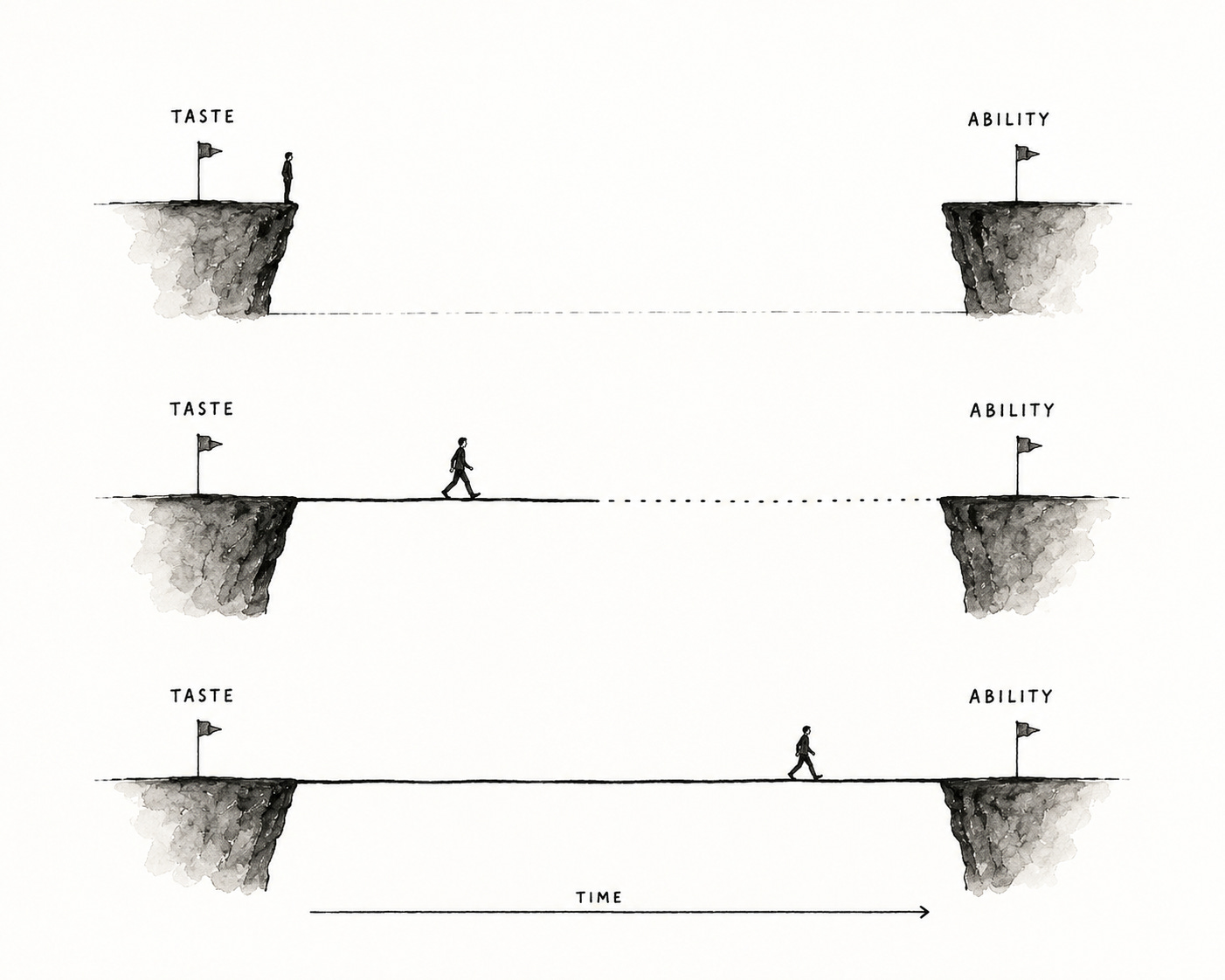
Earlier I described taste as accumulated attention. The same taste that helps us recognize interesting ideas also makes us painfully aware of the distance between what we can imagine and what we’re currently capable of making.
Ira Glass famously described this as the gap between taste and ability. Long before you’re capable of producing great work, you’re capable of recognizing it. Which means that for a period of time—sometimes a very long period of time—you end up disappointing yourself.
The gap hurts.
And I think most of us spend a surprising amount of energy trying to avoid that feeling.
Perfectionism is one way of avoiding it. Endless preparation is another. Waiting for more confidence, more certainty, more time, more skill, more proof that the effort will be worth it.
The problem is that creativity doesn’t seem particularly interested in those conditions.
Most of the projects I’m proud of started before I felt ready for them. Most of the things I’ve learned came from doing something badly long enough to eventually become competent. Most of the creative people I admire seem to have arrived at a similar conclusion: the work gets better because you make it, not before you make it.
Which brings me to what may be the least glamorous observation in this entire essay: volume matters.
Not because quantity is the goal, but because it’s the price of quality.
You learn by making. You discover your voice by making. You develop judgment by making. And eventually, if you keep going long enough, your abilities begin to catch up with your ambitions.
The people we think of as creative usually aren’t the people who never experienced the gap.
They’re the people who kept making things until it became smaller.
And Then There’s AI
AI doesn’t change the questions I’ve been asking.
If anything, it makes them impossible to ignore.
It’s impossible to write an essay about creativity in 2026 without eventually talking about AI.
I resisted including this section for a while. Not because AI isn’t relevant, but because it has a way of flattening every conversation into the same debate. I wanted this essay to be about creativity first, and AI second.
Still, it feels dishonest to leave it out, especially because my own relationship with it has changed so dramatically.
When I first started using AI for writing, brainstorming, coding, image generation, and research, I felt uncomfortable.
Not because the outputs were bad. Quite the opposite.
It felt like cheating. As though I had somehow skipped a step that was supposed to belong to me.
The longer I’ve worked with AI, the less convinced I’ve become that effort is the thing we’re actually valuing. If it were, we’d admire people for digging holes with spoons instead of shovels.
What we tend to value is judgment. Perspective. The choices people make once the tool is in their hands.
And that’s where things become interesting.
AI appears to compress many of the mechanical parts of creativity. It can generate ten ideas where I might have generated one. It can produce a first draft in seconds. It can create images, summarize books, write code, analyze data, and act as an endlessly patient collaborator.
In some ways, it shortens the distance between imagination and execution.
And yet something still feels unresolved.
Earlier I argued that creativity is more than combination. It’s also a manifestation of self.
AI has only strengthened that belief.
Two people can sit down with the same model and produce entirely different things. Not because the model changed, but because the people did. Their experiences are different. Their interests are different. Their obsessions are different. The questions they keep returning to are different.
A good example is Iqra, a personal AI agent I’ve been building as an extension of my own memory, reading, notes, interests, and thinking. Standing it up has been one of the more interesting creative projects I’ve worked on recently—not because of the technology itself, but because of what it revealed.
At its core, Iqra is just a tool. But the more time I spend with it, the more convinced I’ve become that the value isn’t in the model. It’s in what you bring to it.
Its usefulness is shaped by the books I’ve read, the notes I’ve taken, the questions I ask, the ideas I’ve collected, and the connections I’m interested in making. The more I guide it with my own perspective, the more useful it becomes. More aligned. More capable of helping me do the things I already do.
Which is why I keep coming back to the same conclusion: what matters isn’t the model.
It’s the person using it.
At the same time, I don’t think all the questions are settled.
I still wonder where the line is. I still wonder what constitutes authorship. I still wonder whether there’s a meaningful difference between using a tool and outsourcing a process. I still wonder whether some forms of creative friction are valuable precisely because they’re difficult.
I don’t have satisfying answers to any of those questions yet.
What I do know is that AI hasn’t made me less interested in creativity.
It’s made me more interested.
Because for the first time in a long time, we’re being forced to ask what creativity actually is.
And that’s a far more interesting question than whether a machine can imitate it.
Live a Creative Life
When I started reading about creativity, I thought I was trying to understand where ideas came from.
It took me much longer to realize I was really trying to understand myself.
For years I thought I was trying to figure out what I wanted to do with my life.
Writing, startups, photography, design, technology, books, AI—every few years a new interest would show up and convince me it might be the one.
It never happened.
What happened instead was that I slowly realized they were all connected. Not because they belonged to the same industry or discipline, but because they were all expressions of the same impulse.
I don’t think this essay has given me a better definition of creativity.
If anything, it’s done the opposite.
The more I’ve learned, the less interested I’ve become in drawing a boundary around creativity and deciding what qualifies.
I’m more interested in the habits that seem to produce it. Staying curious. Collecting ideas. Paying attention. Making things. Following questions long enough to see where they lead.
That’s why Rodriguez’s quote has stayed with me for so many years. Not because it defines creativity, but because it quietly sidesteps the question altogether.
Rather than asking what creativity is, it asks something simpler: How do you want to live?
Robert Rodriguez’s version is probably better.
Live a creative life.